Book Review of Designing Your Life
Book By Bill Burnett & Dave Evans
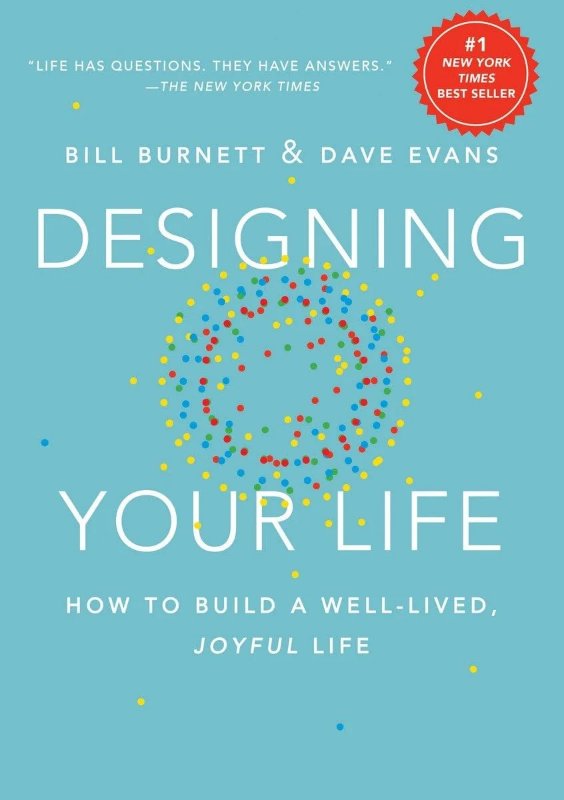
I am presenting the book review of designing your life authored by Stanford Professors Bill Burnett and Dave Evans.
I have read my fair share of personal development books that promise to transform your life in many different ways or claim they've cracked the code to happiness.
Though, I was prepared for more of the same recycled advice dressed up in new packaging, but I was wrong, and I'm genuinely happy about that.
About The Authors
 Bill Burnett
 Dave Evans
Two professors from Stanford University
Will Burnet & Dave Evans
Bill Burnett
Bill Burnett is Executive Director of Stanford's Design Program and Adjunct Professor of Mechanical Engineering.
His fascination with design began as a child drawing under his grandmother's sewing machine, later discovering design as a profession at university.
Over 45 years and five companies, he's designed award-winning Apple laptops and Star Wars action toys, earning multiple mechanical and design patents.
He holds Bachelor's and Master's degrees in Product Design from Stanford.
Beyond teaching thousands of students, he leads Stanford's Life Design Lab and advises student startups, all while maintaining genuine enthusiasm for creating and building things.
Dave Evans
Dave Evans is a Stanford Product Design lecturer, management consultant, and Electronic Arts co-founder.
His career spanned marine biology aspirations, mechanical engineering, alternative energy, and pivotal roles at Apple (mouse team, laser printing) and EA (first VP of Talent).
Recognizing his talent for building creative organizational cultures, Dave transitioned to independent consulting, helping startups, executives, and young adults answer "What should I do with my life?"
This work eventually led him to teach at Cal and Stanford.
He holds mechanical engineering degrees from Stanford and a graduate diploma in Contemplative Spirituality.
What This Book Review of Designing Your Life Captures
Book review of Designing Your life provides my first hand experience after reading hundreds of books on personal growth. I will present my take and review on it my way.
But in a nutshell this book hooked me and brought some very simplistically fresh creative angle to find your true self by using 'Design Thinking'.
The Core Message: Your Life Isn't a Problem to Solve, It's a Design Challenge
The central premise of this book review of Designing Your Life is refreshingly different from what you'd expect.
Burnett and Evans, who teach a wildly popular course at Stanford's design school, argue that we've been thinking about our lives all wrong.
We treat our careers, relationships, and personal fulfillment like puzzles with a single "correct" answer waiting to be discovered, as if somewhere out there is the "right" job or the "right" path, and our job is simply to find it.
Instead, the authors borrow principles from design thinking (the same methodology used to create innovative products and solve complex problems) and apply them to the messy, unpredictable process of building a meaningful life.
The idea is simple but profound: your life isn't something you find, it's something you actively design, build, test, and redesign continuously.
This isn't about having a five-year plan set in stone.
It's about approaching your life with curiosity, a bias toward action, reframing your problems, and understanding that you'll go through multiple versions before you get it "right" and even then, "right" will keep changing.
Why This Book Stands Apart From the Crowd

After finishing this book, I found myself nodding along frequently with many observations and just a few reservations which I will also share at the end.
I find this book effective and different from many personal development books.
It doesn't offer a one-size-fits-all formula to find the right thing right away.
This, for me, is the heart of what makes "Designing Your Life" so valuable.
That is also one of reasons, I was prompted to write a book review of Designing Your Life.
Think about how many books you've read that basically say, "Follow your passion," or "Find your why," or "Here's the exact formula that worked for me, so it'll work for you too."
Though these books may have their own take and experiences to share, I still don't find them wrong.
But Burnett and Evans presented their own different creative take.
Instead, they're upfront about the fact that designing a life worth living is inherently messy, iterative, and personal.
There's no universal blueprint because you're not solving the same problem as everyone else.
Your version of a good life might look completely different from your neighbor's, your best friend's, or even your own sibling's.
The book respects that complexity instead of trying to flatten it into a neat little checklist.
The authors do give you plenty of tools and frameworks but they're designed to help you discover your own answers rather than hand you someone else's. That distinction matters much.
Real Stories That Make the Abstract Concrete

Another thing that struck me while preparing the book review of Designing Your Life was how the authors ground every concept in real, relatable case studies.
You'll meet people from all walks of life: engineers who feel trapped in successful but soul-crushing careers, retirees wondering what's next, young graduates paralyzed by too many options, and mid-career professionals questioning if they've wasted their best years.
These aren't hypothetical scenarios dreamed up to illustrate a point. They're drawn from actual students and workshop participants who went through the exact exercises the book teaches.
This matters because personal development advice can feel incredibly abstract when it's not anchored in reality.
It's one thing to say "reframe your problem," but it's another to watch someone actually do it to see how a woman stuck in a soul-sucking corporate job realized her "problem" wasn't her job at all, but her definition of what success should look like.
These stories give you permission to see yourself in similar situations, and more importantly, they show you that change is possible even when you feel completely stuck.
The Concept of Continuous Questing ...

One more area which I would like to mention in my book review of Designing Your Life for reflection.
The concept of continuous questing, trying new things, discovering what actually resonates well, and then mastering it, is indeed a very practical and refreshing concept for designing our lives better with patience and understanding.
This idea of "continuous questing" might be the single most liberating concept in the entire book.
We live in a culture obsessed with finding our "one true calling" as if it's sitting there waiting to be discovered, fully formed, the moment we're ready to receive it.
This creates enormous pressure and, frankly, a lot of anxiety.
What if I choose wrong?
What if I miss my calling?
What if everyone else has figured this out and I haven't?
Burnett and Evans dismantle this myth beautifully.
They argue that life design is an ongoing process of trying things, paying attention to how those things make you feel (both energized and drained), and using that data to inform your next experiment.
You're not trying to find the perfect answer on your first attempt.
You're building a practice of continuous discovery.
This is where the design thinking methodology really shines.
In product design, nobody expects the first prototype to be perfect.
You build something, test it, gather feedback, and iterate.
The authors apply this exact same logic to your career, your relationships, and your overall life satisfaction.
You try something, maybe it's a new hobby, a side project, a different way of structuring your work day, and you pay attention to what happens.
Does it energize you?
Does it feel authentic?
Does it align with your values?
If yes, you lean into it further.
If no, that's not failure, that's valuable information that helps you calibrate your next move.
What I find so refreshing about this approach is that it removes the confusion that comes from thinking you need to have it all figured out before you start.
You don't need a five-year plan with guaranteed outcomes.
You just need to be willing to try something, observe honestly, and adjust.
This patient, iterative approach feels so much more human and sustainable than the "find your passion overnight" narrative we're constantly fed.
Starting From Where You Actually Are

Another important aspect to cover in this book review of designing Your Life is what the authors call "starting from where you are."
The essential concept of starting from Where We Are is practical and involves gauging and scoring our life in four areas: Work, Play, Health & Love.
This might sound almost too simple, but its power lies precisely in that simplicity.
Before you can design where you want to go, you need brutal honesty about where you currently stand.
The book introduces what they call a "Life Dashboard," where you score yourself across four key dimensions i.e. Work, Play, Health, and Love, giving yourself an honest assessment of how each area is functioning right now.
I found this exercise surprisingly revealing when I tried it myself. (I used a scale 1-10).
I scored myself as Work: 6; Play: 7; Health: 5; Love: 9
Work: In work, I am doing Ok, but I still want my most desired work area (writing & publishing)
Play: I do hang out with friends and go on vacation, listen to music and watch movies, but it is occasional, not very regular.
Health: At 60, I am still doing fine, but undergoing some underline issues of BP, BSL and heart related. But everything is managed well, and I am actively working, but it still requires some lifestyle changes.
Love: I am blessed to have lots of love in my life from my spouse, children, friends and family. I believe in living a peaceful life with giving and caring approach.
If you do happen to read this book, you can build your own Dashboard.
Though it may not be a perfect scoring at the start, you have the freedom to make many versions of it.
It's easy to feel a vague sense that "something's off" in your life without being able to pinpoint exactly what or why.
But when you break it down into these four specific categories and actually score them, patterns emerge.
Maybe your work life is thriving, but your health has been neglected for months.
Maybe you've got great relationships (Love) but zero time carved out for genuine Play or leisure.
This framework does something crucial: it prevents you from making the common mistake of trying to fix your "whole life" as one problem.
Instead, it helps you see that life satisfaction comes from balance across multiple domains, and it gives you a concrete starting point.
You can't navigate toward a better future if you don't have an honest read on your current coordinates.
This isn't about judgment or shame, it's about clarity.
And clarity, as anyone who's tried to make meaningful life changes knows, is often the hardest thing to come by.
The Odyssey Plan: Seeing Multiple Futures Before Committing to One

One of the most central and interesting concepts not to miss out in this book review of Designing Your Life.
If the four-category life assessment gives you clarity about the present, the "Odyssey Plan" exercise is where the book gets genuinely exciting about the future.
This is another concept I found myself deeply interesting and appreciating.
The concept of three Odyssey Plans for five years each is also a very interesting concept taken from Homer's epic Poem.
It certainly will help us see the projected future better before we commit to one."
The name itself is a clever nod to Homer's "Odyssey," evoking the idea of an epic journey with multiple possible paths and destinations.
The exercise asks you to sketch out three different five-year plans for your life, not just one "correct" path, but three genuinely different possibilities.
The first plan is usually some version of your current trajectory, what happens if you continue doing what you're doing now, just taking it further.
The second plan explores what you'd do if that first option was suddenly no longer available, maybe due to circumstances beyond your control, like industry disruption or a major life change. This forces you to think creatively about alternative directions you might genuinely enjoy.
The third plan is the wild card, the one where money, other people's opinions, and practical constraints don't matter at all. What would you do if you had complete freedom and zero fear of failure or judgment?
My Example on Odyssey Plans:
My First Plan: Continue doing a corporate job
My Second Plan: Start a Copywriting Business or Digital Marketing Agency
My Third Plan: Start a Multimedia Publishing House with books and video documentaries.
What makes this exercise so brilliant is that it fundamentally shifts how you think about decision-making.
Instead of anxiously trying to identify the single "right" path and committing to it prematurely, you're encouraged to genuinely explore multiple possible versions of your future.
You get to sit with each Odyssey Plan, imagine what your life would actually look like, and notice which one resonates most deeply, or which elements from each plan might combine into something entirely new.
This process helps combat the tunnel vision that often accompanies major life decisions.
When we're stressed or anxious about our future, we tend to narrow our options prematurely, often defaulting to whatever feels "safe" or expected, even if it's not truly aligned with what we want.
The Odyssey Plan exercise forces you to widen your aperture, to genuinely consider alternatives you might have dismissed out of hand, and to make more informed choices because you can actually visualize different futures before committing to one.
Final Thoughts with some Commentary

What ultimately makes "Designing Your Life" so valuable isn't any single concept, it's the overall philosophy and toolkit the authors provide.
This book won't hand you a five-step plan to instant happiness, but it will give you genuinely useful frameworks for approaching life's biggest questions with curiosity, patience & experimentation, instead of anxiety, desperation, and paralysis.
If you're feeling stuck, uncertain about your next career move, questioning whether you're living authentically, or simply curious about applying design thinking principles to your own life, this book deserves a place on your shelf.
I have prepared this book review of Designing Your Life from my perspective. And I do believe every one can follow his or her own journey of exploration.
I'd recommend approaching this book not as something to read once and shelve, but as a working document, one you'll likely return to multiple times as your life circumstances change and evolve.
After all, if the book teaches us anything, it's that designing your life isn't a one-time event.
It's an ongoing, iterative process that continues throughout your entire life journey.
That's exactly the kind of honest, sustainable approach to personal growth I think more of us need.
Some Analytical COMMENTARY
As expressed, in my above book review of Designing Your Life, I do agree with the fresh creative angle of Design Thinking to apply on our lives.
And, it is not only fresh but most practical way to move forward and explore without any anxiety for failures and mid-life crisis.
However, based on my experience, interestingly and incidentally, another concept which is close is Japanese Ikigai. That happens to sit quite close to this Design Thinking model.
In one way, I also find Ikigai very simplistic for the personal quest.
It aides you with just 4 questions to answer with deep reflection based on your past knowledge & experiences from childhood to present.
Based on your past data, it helps to project what supposedly the right future direction might likely be.
If you wish, you may also read about Ikigai here.
Largely, I agree, that Design Thinking concept makes it more open-ended and continuous.
And probably more practical for most, as most of the people feel stuck without any clear answers.
Although, we all may know it well that there is no one-size-fits-all approach in life.
Therefore, I strongly believe that despite having many different thoughts, models and propositions, it depends from person to person what will suit him or her better.
As per psychological models, some are right brained (creative) and some are left brained (analytical) and if we happen to take more psychological models, one famous is MBTI with 16 personality types.
Additionally, we may also look at the Zodiac signs which claim to provide you with your inborn traits and traces, about what type of personality you are born with.
Though Astrology and Zodiac signs are not exact science, it is still in the domain of occult, but few authentic sources sometimes give you some matching signs which you just can't disagree with.
The personal quest is important, but at the same time, there are many routes to go through it.
Before you embark upon your personal quest journey, you also have to figure it which route, model and approach appeals and feels right for you.
Designing Your Life, Ikigai, MBTI Assessments, or Astrology.
I do hope that this book review of Designing Your Life may have helped to get the overall essence of the book.
One thing is sure, there is no harm in reading this book, Designing Your Life, whether you apply it not, you will still gain something good out it.
You can also read the Book Review of Designing Your Life Presentation

Zeerik ahmad - Founder, Writer, Author & Marketing Coach
IdeasBeat is primarily a Marketing Consultancy for Micro, Small, & Medium Enterprises (MSMEs) with key focus on digital and content marketing. With 25+ years of corporate experience, I also selectively coach MSME companies. At the same time, I love reading and writing on History. I will bring some selective inspiring stories from all around the world to make you unwind too. You can contact me here
You can read more Book Reviews & Summaries at IdeasBeat