Understanding Startup Valuation Tiers
From Minicorns to Hectocorns
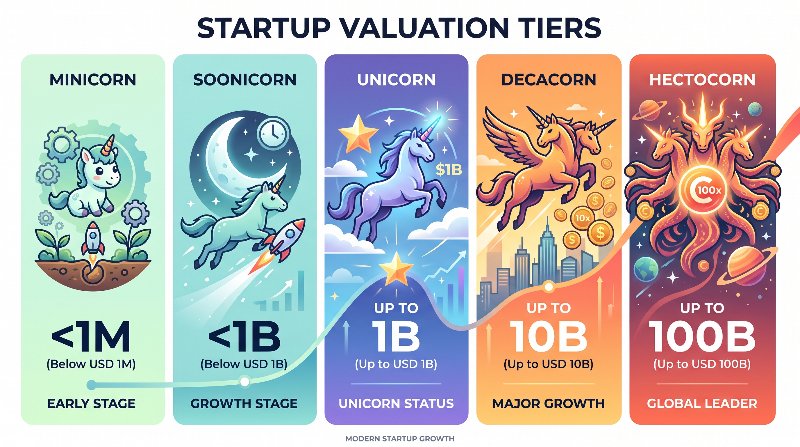
Understanding Startup Valuation Tiers not only help the aspiring entrepreneurs but inspire them to rise and grow.
If you've spent any time reading about the startup world, you've probably come across some pretty whimsical terms — unicorn, decacorn, hectocorn, and even the lesser-known minicorn and soonicorn.
It sounds like something out of a fantasy novel, right?
But these terms actually represent something very real and very important: startup valuation tiers that help investors, founders, and industry watchers categorize companies based on how much they're worth.
Let's break down these startup valuation tiers one by one, explore where they came from, and look at some real-world examples that bring these concepts to life.
Why Do We Even Need Startup Valuation Tiers?
Before we dive into the specific terms, it's worth understanding why the startup ecosystem developed this classification system in the first place.
As venture capital funding exploded over the past couple of decades, and as startups began reaching eye-watering valuations, the industry needed a shorthand way to talk about company worth.
Saying "a company valued at over a billion dollars" every time got clunky.
So, the startup world — being the creative bunch that it is — borrowed a mythical creature to describe these rare, valuable companies, and things snowballed from there.
These startup valuation tiers aren't official, government-mandated categories.
They're more like industry jargon that emerged organically and stuck because they were catchy and useful.
Minicorn: The Humble Beginning

Let's start small — literally.
A minicorn is a startup that has reached a valuation of $1 million.
Yes, just one million. In the grand scheme of startup valuation tiers, this is the entry-level rung on the ladder.
The term "minicorn" isn't as widely used or as precisely defined as its bigger siblings, but it generally refers to early-stage startups that have proven enough traction or product-market fit to be valued at this modest (by Silicon Valley standards) figure.
Think of it as the "off to a promising start" tier.
Because there's no formal registry of minicorns (unlike unicorns, which are tracked closely by firms like CB Insights), it's harder to point to famous examples.
Most minicorns are small startups you've likely never heard of — and that's okay!
They're often bootstrapped companies or those that just closed a modest seed round.
Soonicorn: The Startup on the Cusp of Greatness
This term describes a startup that hasn't yet hit the coveted billion-dollar valuation but is widely expected to get there soon, based on growth trajectory, funding rounds, and investor sentiment.
Soonicorn isn't a precise valuation figure like the others — it's more of a predictive label.
Investors and startup analysts use it to flag companies that are "unicorns in waiting."
You'll often see this term in startup ecosystem reports from countries like India, where analysts track homegrown companies expected to join the unicorn club within a year or two.
For instance, in India's startup scene, publications regularly publish "soonicorn lists" highlighting companies like erstwhile soonicorns Meesho or CRED before they eventually crossed the billion-dollar threshold and became full-fledged unicorns.
The "soonicorn" is mix of "soon" and "unicorn."
Unicorn: The Term That Started It All

Now we arrive at the most famous of all startup valuation tiers: the unicorn. A unicorn is a privately held startup company valued at $1 billion or more.
The term was coined in 2013 by venture capitalist Aileen Lee, founder of Cowboy Ventures, in a TechCrunch article titled "Welcome To The Unicorn Club: Learning From Billion-Dollar Startups."
Aileen Lee chose the word "unicorn" because, at the time, companies reaching a billion-dollar valuation while still private were incredibly rare — almost mythical, like the creature itself.
In her original analysis, she found only 39 unicorns had been created in the previous decade among U.S.-based software companies. That's how rare this feat once was!
Fast forward to today, and the landscape has changed dramatically.
As of recent counts, there are well over 1,200 unicorns globally. Companies like:
- SpaceX (Elon Musk's aerospace company)
- Stripe (the payments processing giant)
- Canva (the design platform)
- Epic Games (makers of Fortnite)
These have all achieved unicorn status at various points.
Some, like SpaceX, have gone on to become worth tens of billions.
The proliferation of unicorns has led some critics to argue the term has lost its original meaning — after all, if there are over a thousand "mythical creatures," how mythical are they really?
This is precisely why the startup world needed to expand its vocabulary further up the ladder.
Decacorn: Ten Times the Magic
As more startups blew past the billion-dollar mark and kept climbing, the term "decacorn" emerged to describe companies valued at $10 billion or more.
The prefix "deca" comes from the Greek word for "ten," fitting nicely with the idea of ten unicorns' worth of value.
Decacorns represent a much more exclusive club within the broader universe of startup valuation tiers. Notable decacorns include:
- ByteDance (parent company of TikTok), one of the most valuable startups in the world
- SpaceX (which has grown from unicorn to decacorn status)
- Stripe (which also climbed from unicorn to decacorn territory)
- Instacart (during its peak private valuation years)
These companies represent industries ranging from social media to fintech to space exploration, showing that decacorn status isn't limited to any single sector.
Hectocorn: The Rarest of the Rare
At the very top of the startup valuation tiers pyramid sits the hectocorn — a term used for startups valued at $100 billion or more.
"Hecto" comes from the Greek prefix for "hundred," making a hectocorn essentially worth 100 unicorns.
This tier is exceptionally exclusive. Historically, companies like:
- ByteDance (which has flirted with hectocorn valuations)
- SpaceX (which crossed the $100 billion valuation threshold in 2022)
- OpenAI (which has reached hectocorn territory following massive investment interest in AI)
These represent this ultra-rare category.
It's worth noting that many companies that reach hectocorn status often go public shortly after, at which point they're no longer technically "startups" in the traditional sense — they graduate into the world of public mega-cap companies.
Why Do Startup Valuation Tiers Matter?
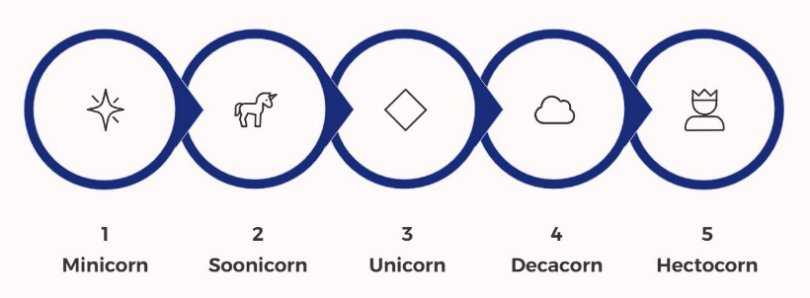
You might be wondering: beyond fun terminology, why do these startup valuation tiers actually matter to the broader business world?
1. They signal market maturity and investor confidence.
When a startup climbs through these tiers, it reflects growing trust from venture capitalists, private equity firms, and eventually public markets.
2. They help benchmark success.
Founders, employees, and investors use these tiers as milestones. Reaching unicorn status, for example, is often seen as a major validation point for a company's business model.
3. They attract talent and media attention.
Startups that achieve unicorn or decacorn status often find it easier to recruit top talent, since employees are drawn to the prestige and potential financial upside of stock options in a high-growth company.
4. They reflect broader economic trends.
The sheer number of unicorns created in the 2020-2021 period, for instance, reflected the abundance of cheap capital and investor enthusiasm during that era. Conversely, a slowdown in new unicorn creation can signal tightening market conditions.
5. They help with global comparisons.
Countries and regions often use the number of unicorns (and beyond) they produce as a point of pride and economic indicator. The U.S. and China have traditionally led unicorn production, but India, the UK, and other nations have been rapidly catching up.
The Bigger Picture
Understanding startup valuation tiers gives you a helpful lens for viewing the startup ecosystem, but it's important to remember that valuation isn't everything.
Many unicorns have failed or seen their valuations crash dramatically once they went public or faced market realities (WeWork, etc.)
Private valuations are often based on optimistic projections and investor sentiment rather than proven, sustainable profitability.
So while it's fun to track which startups have achieved minicorn, soonicorn, unicorn, decacorn, or even hectocorn status, savvy entrepreneurs and investors know that these labels are just one piece of a much larger puzzle.
Real, sustainable business fundamentals — revenue, profitability, customer satisfaction, and long-term vision matter just as much, if not more, than hitting a particular valuation milestone.
Wrapping Up
From humble minicorns to the almost unimaginable hectocorns, startup valuation tiers give us a fun, if imperfect, way to categorize the financial journey of high-growth companies.
Whether you're an aspiring founder dreaming of unicorn status, or just someone fascinated by the mechanics of the startup world, understanding these tiers helps make sense of the numbers we see splashed across tech headlines every day.
Who knows — maybe your own startup idea will someday climb through these very tiers.
Just remember: it all starts with that first minicorn milestone!
You can also read the article presentation here

STAFF WRITER
IdeasBeat is primarily a Marketing Consultancy for Micro Small, & Medium Enterprises (MSMEs) with key focus on digital and content marketing. At the same time, we bring insightful and inspiring stories from all around the world to make you unwind too. We share easy-to-digest articles, ebooks and curated content from selected sources globally.
Browse More Articles on Entrepreneurship